
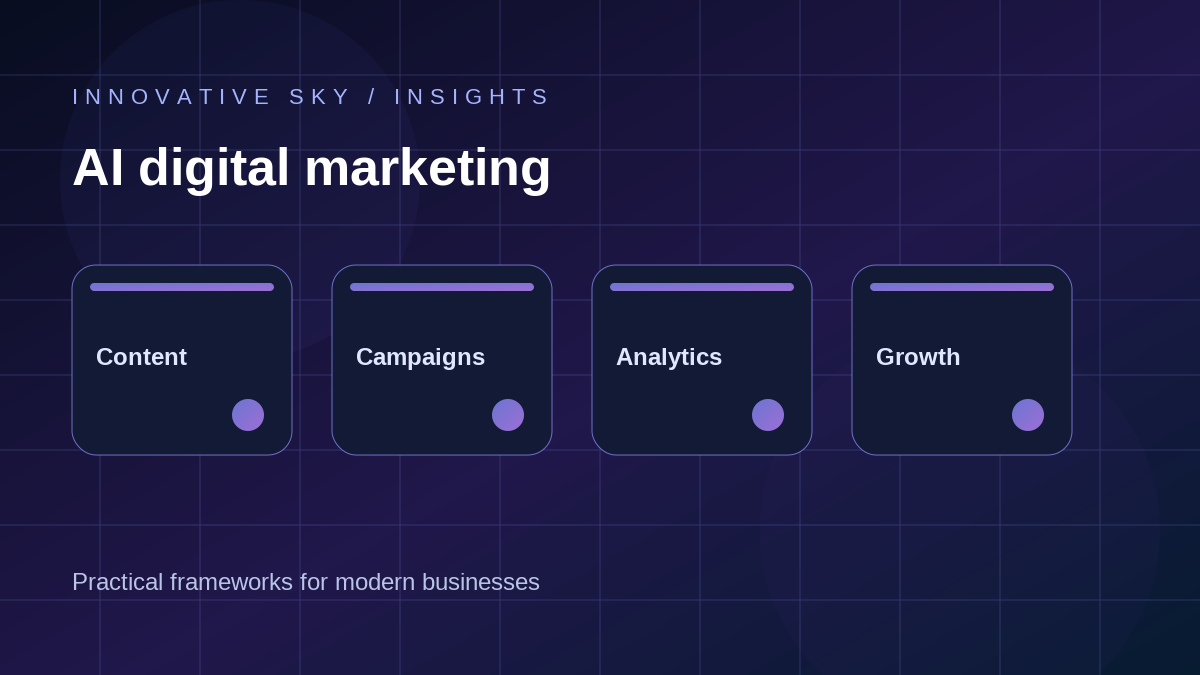
AI as a workflow assistant, not a strategy
AI can accelerate research, drafting, analysis and repetitive execution. It cannot replace a clear audience, offer, positioning, measurement plan or accountability. Start from the customer journey and business objectives, then identify work where AI improves speed, insight or consistency.
Content planning and production
Use AI to organize audience questions, create editorial outlines, repurpose approved material and generate first drafts. Human review should verify claims, tone, examples, originality and relevance. Build a content system with topic clusters, internal links, update dates and clear ownership instead of publishing disconnected AI drafts.
Search, SEO and AI discovery
Search visibility still depends on accessible, useful and trustworthy content, strong technical foundations and the ability to satisfy the visitor. AI-assisted discovery increases the importance of clear entity information, useful answers and original expertise. Avoid claims that a particular markup or prompt guarantees inclusion in AI answers.
Social media and creative operations
AI can help produce platform-specific variants, calendars, captions, creative briefs and repurposed content. Use a brand voice guide, approved claims and visual rules. Review the actual creative, not only the caption, and adapt for each platform rather than copying identical posts everywhere.
Analytics and campaign insights
AI can summarize trends, detect anomalies, compare campaign performance and draft reports. Connect the analysis to trustworthy data and clearly label assumptions. Recommendations should explain the evidence, possible causes and next experiments; automated commentary should not invent attribution or outcomes.
Personalization and customer communication
Personalized experiences can use contextual information to improve relevance, but data minimization, consent, security and transparent communication matter. Avoid sensitive inference and review automated messaging before deployment in high-impact contexts.
Image, video and creative assistance
Generative tools can support concept exploration, storyboards and production variants. Maintain consistency, rights and disclosure policies as appropriate. Use assets that accurately represent products, customers and results; do not use synthetic imagery to imply real testimonials or evidence.
A phased implementation roadmap
Begin with low-risk tasks such as research summaries or draft assistance. Next, add approved workflows, analytics and reusable prompt templates. Introduce automation only after quality checks, ownership, permissions, rollback and measurement are in place. Track time saved, conversion quality and marketing outcomes—not output volume alone.
Practical checklist
- Define the outcome and the audience.
- Measure the current baseline.
- Review evidence, inputs and quality.
- Use validation and human review where needed.
- Track results and keep the workflow updated.
Frequently asked questions
Where should a business start?
Start with a clear task, baseline measurements and representative examples. Use a limited pilot before broad rollout.
Does this guarantee better results?
No single technique guarantees performance. Evaluate changes against quality, reliability, cost and the intended business outcome.
Looking to apply this in your business?
Innovative Sky can help you assess the opportunity, design a practical approach and implement a solution around your goals.
Building a Practical AI Marketing Workflow
Start with customer and campaign data
AI marketing is most useful when inputs are organized. Define audiences, consent, goals, channels, brand voice, campaign history and conversion events. Review data quality and permissions before connecting tools. Avoid treating personal data as an unrestricted prompt source; limit access and remove sensitive information where possible.
Plan content across channels
Build a campaign brief that includes audience, insight, objective, offer, proof, format, channel, CTA and measurement. AI can help draft variants and repurpose material, but each channel needs its own format and context. Review claims, tone, accessibility and platform rules before publication. Use a content calendar as an operational plan, not a substitute for strategy.
Personalization with boundaries
Use meaningful segmentation and context to tailor communications. Avoid sensitive inference or over-personalization that can feel intrusive. Test whether personalization improves useful outcomes such as qualified leads, engagement or retention. Maintain consent, suppression lists and clear unsubscribe mechanisms for applicable channels.
AI-assisted search and content discovery
Content strategy should answer real customer questions and demonstrate experience. Improve technical crawlability, content structure, topical coverage and entity consistency. Use AI to support research and drafting, not to mass-produce near-duplicate pages. Review sources, original insight, expertise and usefulness before publishing.
Creative production and review
AI can assist with image concepts, video scripts, storyboards and variants. Establish a brand asset library, creative brief and review checklist. Check rights, accuracy, representation, product details and disclosure requirements. Maintain human approval for final creative where brand or compliance risk warrants it.
Measure the marketing system
Connect activities to outcomes. Track qualified leads, conversion rate, cost per acquisition, retention, revenue contribution and assisted conversions where available. Compare experiments against a baseline and document attribution limits. Avoid reporting AI-generated output volume as a business result.
A staged adoption roadmap
Begin with low-risk assistance such as briefs, repurposing, reporting summaries and draft generation. Next, connect approved data sources and workflow tools with review checkpoints. Automate repetitive actions only after quality and permissions are established. Assign owners, define escalation paths and review performance on a recurring basis.
Examples, evaluation and implementation checklist
Example: campaign workflow for a service business
A service business can begin with a quarterly objective and customer questions, then create an editorial brief, draft a landing page, social posts and a newsletter variation. AI may help produce initial drafts and organize variants, while staff verify service details, pricing, claims and availability. Publish only after review. Use analytics to identify which content attracts qualified enquiries, then update the next campaign based on evidence rather than simply generating more posts.
Governance and brand safeguards
Create a short policy describing approved tools, data restrictions, disclosure expectations, brand voice, review responsibilities and escalation. Keep the policy practical enough for everyday use. Review generated claims, testimonials, statistics, image rights, privacy and accessibility. Maintain versioned brand guidelines and a source library so the system does not invent product facts or drift from the brand.
Advanced considerations and frequently asked questions
Build a reusable campaign brief
A campaign brief should capture the business objective, audience, customer insight, offer, proof points, brand voice, channels, formats, CTA, constraints and measurement. Reuse the brief to create drafts for different channels, but review each draft for the channel and audience. Store approved facts and claims in a source library. This reduces inconsistency and helps reviewers distinguish supported statements from generated suggestions.
Workflow example from planning to learning
A team can review performance and customer questions, select one campaign objective, create a brief and produce content variants. A reviewer checks claims and creative. The team publishes, measures the agreed outcomes and records lessons. AI may assist at each stage, but the team remains responsible for strategy, accuracy, audience respect and the interpretation of results. This process produces a learning loop instead of an endless content-generation loop.
FAQ: will AI replace marketing strategy?
AI can accelerate research, drafting, organization and analysis, but strategy still depends on business context, customer understanding, differentiation, creative judgment and accountability. Use AI to support decisions and execution, then validate results against real customer and business outcomes.
Operational practices and maintenance
Use AI to support insight, not fabricate it
AI-generated market summaries should be treated as hypotheses until supported by evidence. Validate customer statements against interviews, support tickets, surveys, search data or analytics that your organization is permitted to use. Do not fabricate testimonials, case study results, survey findings or customer quotations. If a generated insight informs a campaign, retain the source material and explain how the conclusion was reached. This discipline makes campaigns more useful and protects credibility.
Make experimentation part of the process
Test a limited number of variants with a clear hypothesis, audience, metric and duration. Avoid changing too many elements simultaneously. Ensure that the test is large and long enough to provide useful evidence, and recognize limitations. Record results and share what was learned even when the experiment fails. AI can help organize the analysis or suggest next tests, but it should not turn weak data into confident claims.