
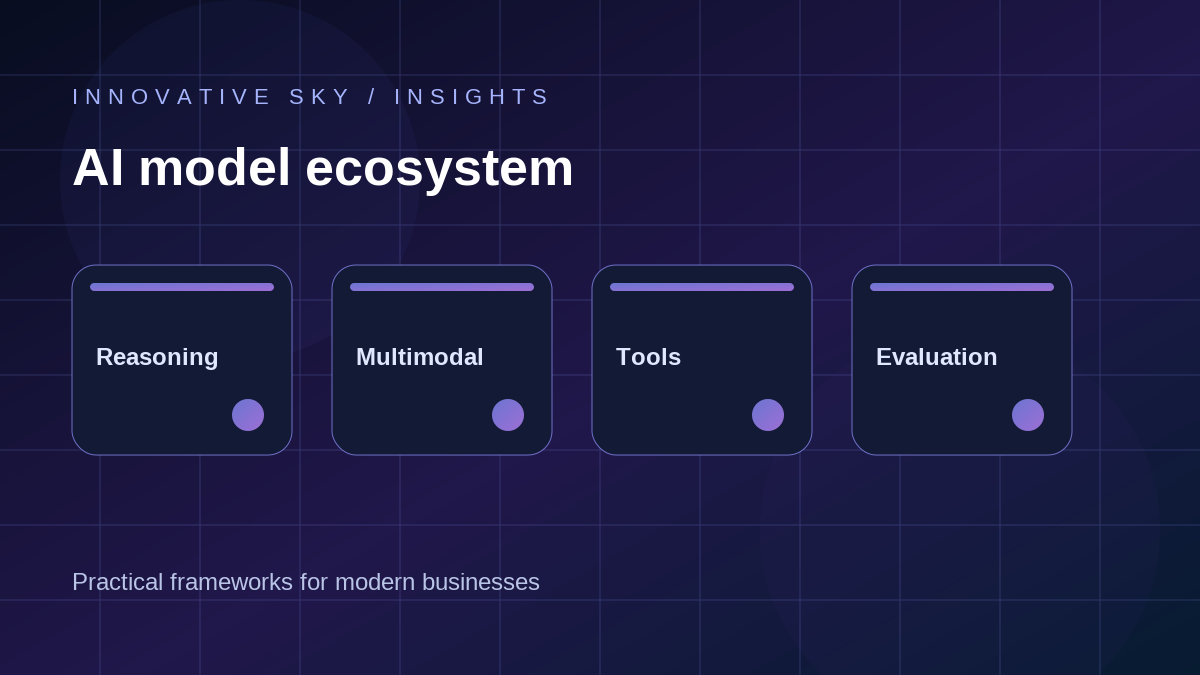
Why model selection is more than a leaderboard
Model rankings can change quickly and benchmark results do not guarantee performance on your own tasks. A model that excels at coding may be less suitable for a workflow involving long documents, image interpretation, strict structured output or customer-facing reliability. Define the task and constraints before comparing vendors.
Reasoning and multi-step problem solving
Reasoning-oriented models are designed for tasks that benefit from deliberate analysis, planning or complex instruction following. They may be useful for debugging, research synthesis, planning and multi-step workflows. Evaluate whether the added capability justifies extra latency or cost. Use deterministic tools and validation for calculations and actions rather than relying on text reasoning alone.
Multimodal capabilities
Models may accept or generate combinations of text, images, audio and video. These capabilities can support document understanding, image analysis, voice experiences and richer content workflows. Check supported formats, limits, quality, privacy, processing cost and whether the capability is available in the API or product tier you intend to use.
Coding and software workflows
Coding models can assist with explanation, test generation, refactoring and implementation, but repository-level work still requires source inspection, tests, review and security checks. Evaluate on your actual stack, project conventions, dependencies and test suite. Avoid treating benchmark scores as proof that code is production-ready.
Context, tool use and structured output
Compare context-window limits, tool/function calling, structured-output support, rate limits and behaviour under long context. A large context window is useful only when the model can use the supplied information accurately. Validate generated JSON, tool arguments and outputs at the application boundary.
Open-weight and hosted options
Hosted models can simplify operations and provide managed infrastructure. Open-weight models may offer deployment control, customization or cost advantages at scale, but introduce hosting, security, monitoring and maintenance responsibilities. Compare total operational cost and compliance requirements, not only inference price.
A model-selection scorecard
Test representative inputs and score accuracy, completeness, safety, latency, cost, consistency and ease of integration. Include failure cases and evaluate the model’s ability to refuse or escalate when appropriate. Maintain an abstraction layer where possible so provider or model changes do not require rewriting business logic.
Keep comparisons current
Model names, capabilities, limits and prices evolve. Before publishing a specific comparison, verify the details against official provider documentation and note the review date. This article focuses on selection principles rather than asserting a permanent ranking.
Practical checklist
- Define the outcome and the audience.
- Measure the current baseline.
- Review evidence, inputs and quality.
- Use validation and human review where needed.
- Track results and keep the workflow updated.
Frequently asked questions
Where should a business start?
Start with a clear task, baseline measurements and representative examples. Use a limited pilot before broad rollout.
Does this guarantee better results?
No single technique guarantees performance. Evaluate changes against quality, reliability, cost and the intended business outcome.
Looking to apply this in your business?
Innovative Sky can help you assess the opportunity, design a practical approach and implement a solution around your goals.
A Practical Framework for Evaluating AI Models
Evaluate capabilities, not hype
Model names and leaderboards change quickly. Define the task first: summarization, coding, document extraction, image understanding, tool use, reasoning, voice or customer-facing dialogue. Create a small test set based on real work, include edge cases and score outputs against clear criteria. Vendor benchmarks can inform the shortlist but should not replace testing with your own data and workflow.
Context windows and long-document work
A large context window can help with lengthy documents, but capacity alone does not guarantee reliable retrieval or synthesis. Test whether the model can locate key facts, reconcile conflicting passages, preserve citations and follow instructions near the beginning and end of inputs. Consider retrieval and staged processing for very large corpora, and avoid sending unnecessary material.
Reasoning, tool use and agents
Reasoning-oriented models may help with tasks that require planning or multi-step analysis, but latency and cost can rise. Tool-use performance should be evaluated separately: does the model select the correct tool, provide valid arguments, handle failures and ask for approval when required? Agent workflows need boundaries, logging, permission checks and human review for consequential actions.
Multimodal capabilities
Assess image, audio, video and document capabilities only where they serve a real use case. Test image interpretation with representative quality and lighting, audio with accents and noise, and document extraction with scans and tables. Keep accessibility and privacy considerations in the evaluation. Capability availability and limits can vary by model, region and API.
Open-weight and hosted options
Compare operational requirements alongside performance. Hosted services may reduce infrastructure overhead and offer managed scaling; open-weight options can provide deployment flexibility but require evaluation of hosting, monitoring, security, updates and support. Neither approach is universally superior. Consider data governance, latency, workload volume and engineering capacity.
Model selection matrix
Use a weighted evaluation that includes task quality, factual reliability, latency, cost per successful task, tool reliability, privacy controls, availability and maintainability. Define minimum thresholds before scoring. Include failure handling and revision cost in the total-cost calculation. Re-evaluate periodically because providers release new models and change service conditions.
Keep the comparison current
Before publishing a model comparison or choosing a provider, verify model names, API availability, context limits, pricing, supported modalities and retirement notices on official provider documentation. Date-stamp comparisons and avoid claims such as “best model” without a stated test methodology and scope.
Examples, evaluation and implementation checklist
A realistic evaluation exercise
Select ten to fifty representative examples for a first evaluation, depending on workflow complexity. Include normal cases, ambiguous inputs, edge cases, incomplete information and adversarial instructions. Define what a correct response must include and what it must not do. Run each shortlisted model under comparable conditions and record qualitative failure patterns alongside numerical scores. For tool-based workflows, test tool selection, argument validity, recovery and confirmation behavior.
Deployment and lifecycle questions
Before committing, ask how the provider handles data, retention, regional availability, rate limits, service outages, version changes and model retirement. Review whether your application can swap models through a configuration layer and whether prompt and evaluation versions are tracked. A model decision should not lock the organization into an undocumented dependency.
Advanced considerations and frequently asked questions
Testing a model in your own application
For a customer-facing assistant, test how the model behaves when information is missing, when a user changes requirements, when documents disagree and when a tool fails. For a coding assistant, test codebase-specific tasks, edits, debugging, tests and whether it respects project constraints. For document processing, measure field extraction and evidence traceability. A model that performs well in a general benchmark may still be unsuitable for a specialized workflow.
Cost per successful outcome
A useful comparison is the total cost required to complete an acceptable task. Include input and output usage, tools, retries, human review, latency and failure recovery. Compare models using the same evaluation cases and equivalent application context. Consider quality thresholds and operational constraints before optimizing price. Keep a record of the date, provider version and test configuration so the comparison can be repeated.
FAQ: should every business use the newest model?
Not necessarily. A stable, well-tested model may be more appropriate than a newer model for a routine workflow. Re-test when new capabilities become available, but consider reliability, privacy, availability, integration effort and total cost. Model selection is an ongoing evaluation process rather than a one-time popularity decision.
Operational practices and maintenance
Practical governance for model changes
Treat model upgrades as controlled changes. Keep a record of provider, model identifier, date, prompt version, evaluation set and thresholds. When a provider updates a model or endpoint, run regression tests before routing production traffic. Use a canary or limited rollout where possible and monitor unexpected output changes. Preserve a fallback model or manual process for critical workflows. Communicate material changes to users when they affect behavior, and avoid assuming that a model alias always refers to an unchanged version.
Making the evaluation decision
A decision memo should explain the use case, candidate models, evaluation method, observed strengths and weaknesses, operational constraints and recommendation. State where the test is inconclusive. The best model may differ by task or data type; a routing strategy can be appropriate if it is maintainable and tested. Revisit the decision when usage patterns, provider conditions or requirements change, but avoid frequent switching without evidence of benefit.